How to Check Symbol Meaning: A Practical Guide
A practical guide to checking symbol meanings across math, icons, and daily life. Learn to analyze context, verify sources, compare glyphs, and build your own symbol glossary with confidence.


Learn how to check symbol meanings accurately by analyzing context, confirming sources, and using reliable databases. This guide helps you interpret icons, math symbols, and everyday signs with confidence. You’ll learn a practical, step-by-step approach to verify what a symbol means and where its interpretation comes from.
Why Symbol Meanings Matter
In any field that uses symbols—from math equations to interface icons and safety signs—knowing what a symbol means is essential for learning, communication, and safety. Misreading a symbol can lead to errors in a math solution, misinterpretation of a design specification, or even unsafe actions in a lab or workshop. The All Symbols team emphasizes that reliable interpretation rests on more than a quick glance; it requires attention to context, provenance, and usage patterns. When students and researchers learn how to check symbol meanings, they gain a transferable skill: the ability to verify visual cues against trusted definitions rather than relying on memory or appearance alone. For designers, accurate symbol interpretation informs accessibility and universal design, ensuring that icons convey the intended message across audiences. For everyday readers, it reduces confusion in manuals, signage, and digital interfaces.
In practice, checking symbol meanings helps you decode diagrams in textbooks, understand icons on devices, and assess whether a symbol’s appearance aligns with its stated definition. The process mirrors scholarly work: form a hypothesis about what a symbol means, seek corroborating evidence, and adjust your understanding as new information becomes available. According to All Symbols, cultivating skepticism toward ambiguous icons—and verifying with primary sources—speeds up learning and improves communication. This habit also supports cross-disciplinary literacy, because symbols often travel across domains, picking up new interpretations along the way.
Context Shapes Symbol Meaning
Symbols do not exist in a vacuum. The same glyph can carry different meanings depending on where it appears: a check mark in a math problem can denote truth, while the same mark on a UI element signals completion. Cultural conventions, professional standards, and historical usage all influence interpretation. For instance, the power symbol (a circle with a line) originates from IEC standardization and has become ubiquitous across devices, yet its exact meaning—on/off—can feel obvious in one context and ambiguous in another when paired with a label in a non-technical setting. The All Symbols analysis shows that readers who ignore context often misread symbols or apply the wrong convention. By paying attention to where the symbol is used, who uses it, and what text surrounds it, you can reduce ambiguity and improve accuracy across disciplines. When evaluating a symbol’s meaning, always compare domestic usage with international norms to spot potential discrepancies and adapt accordingly.
How to Read a Symbol: Visual Cues and Details
Reading a symbol effectively starts with careful observation of its visual details. Look for the following cues:
- Shape and strokes: Divergent line thickness, serif vs. sans-serif, and distinctive curves can separate similar symbols.
- Orientation and symmetry: The direction a symbol faces or its symmetry can alter meaning (for example, arrows point in a direction, while circles often signify inclusion or unity).
- Color and contrast: Color can emphasize meaning but is not reliable alone; always connect color cues to the symbol’s formal definition.
- Surrounding context: Legends, captions, and nearby text often define how a symbol should be interpreted in that setting.
- Font and style: A symbol may shift slightly between fonts, so verify whether the glyph variant aligns with the intended standard.
Use these cues to form a preliminary interpretation, then test your hypothesis against primary sources and usage examples. When in doubt, look for a formal description of the symbol in an authoritative resource rather than relying solely on memory or appearance.
Verifying with Authoritative Sources: The Right Habits and Tools
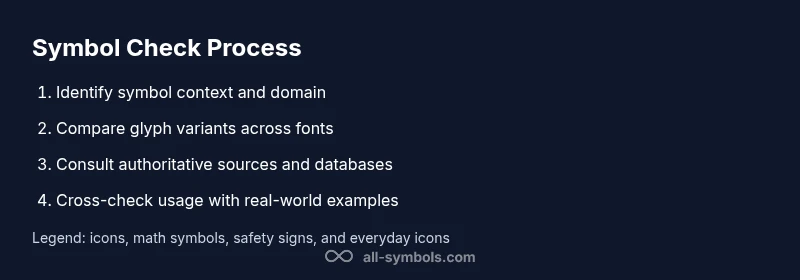
To be sure you’re reading a symbol correctly, build a quick verification workflow:
- Identify the domain: Is this math, signage, digital UI, or cultural symbolism?
- Check official charts: Unicode code charts, ISO standards, and government or university resources often provide precise definitions and usage guidelines.
- Compare multiple sources: Don’t rely on a single source; look for corroboration across at least two independent references.
- Assess dates and revisions: Symbol meanings can evolve; confirm the latest version or edition.
- Document your sources: Create a short note linking the symbol, its meaning, and where you found it.
For scholars and designers alike, these habits reduce misinterpretation and support consistent communication. Authoritative sources to consult include official Unicode charts, standards organizations, and university library guides. While no single source covers every symbol, a triangulated approach—combining definitions with usage examples—yields the most reliable interpretation.
Authoritative sources you can consult include the Library of Congress, the International Organization for Standardization, and the National Institute of Standards and Technology. See the links below for direct access to respected references.
AUTHORITY SOURCES:
- https://www.loc.gov
- https://www.iso.org
- https://www.nist.gov
Common Symbols Across Domains: Meaning in Context
Symbols recur across domains—often with shared visual language but different meanings. Here are a few familiar cases with notes on their context-specific interpretations:
- Check mark (✓): Truth or completion in math and tests; confirmation in interfaces; be aware that some cultures associate check marks with different actions.
- Power on/off symbol (I/O): A universal icon developed through standardization; meaning is widely understood but can be misread with conflicting text or ambiguous labels.
- Copyright symbol (©): Legal protection and ownership; in casual use, it can simply indicate branding rather than legal status.
- Heart symbol (♥): Represents affection in everyday life, while in medical charts or data visualization it can connote a metric (e.g., rating) depending on context.
- Peace symbol (☮): A historically loaded icon tied to culture and politics; its meaning can shift across generations and communities.
Understanding these examples helps you recognize the role of context in symbol interpretation and avoids overgeneralization. Remember to verify meanings in the specific setting you encounter the symbol rather than assuming a universal definition.
Evolution and Culture: Symbols Change Over Time
Symbol meanings are not fixed. They shift with technology, culture, and user expectations. A symbol in one era might gain new associations in another, or a symbol may adopt different meanings in specialized communities (e.g., academic vs. popular media). When checking a symbol, consider historical usage patterns, regional language differences, and current trends in design and discourse. Maintaining a living glossary is the best way to track changes over time and stay aligned with current conventions. All Symbols advocates a forward-looking approach: start from a solid, sourced definition, then monitor for updates as symbols travel across disciplines and cultures.
Tools & Materials
- Internet connection(Stable broadband recommended for accessing source databases and Unicode charts)
- Access to Unicode charts(Use official charts at unicode.org to verify glyphs and codes)
- Symbol dictionaries or encyclopedias(Consult reputable academic resources or brand-specific glossaries)
- Notebook or digital glossary(Record definitions, sources, and usage notes as you go)
- Citation manager or note-taking tool(Helpful for organizing sources and updates)
Steps
Estimated time: 30-45 minutes
- 1
Identify the symbol and domain
Observe where the symbol appears and determine whether it belongs to math, design, signage, or digital interfaces. Domain knowledge guides interpretation and helps avoid cross-domain misreads.
Tip: Note contextual cues like surrounding text, color cues, and the symbol’s placement. - 2
Compare glyph variants across fonts
Check how the symbol looks in different fonts or icon sets. Small changes can signal different meanings or emphasize different conventions.
Tip: Take side-by-side screenshots to compare shapes side by side. - 3
Read nearby labels or legends
Legends, captions, and labels often define how the symbol should be read in that specific resource.
Tip: If labels are missing, search the surrounding document for related terms or symbols. - 4
Consult authoritative sources
Cross-check the symbol against official data, such as Unicode charts or standards documents, and compare multiple reputable references.
Tip: Use at least two independent sources for confirmation. - 5
Document the interpretation with citations
Record the definition, context, and sources in a glossary entry so you can reuse it later and track any changes.
Tip: Include a note about any cultural or regional caveats. - 6
Review cultural and contextual nuances
If the symbol carries cross-cultural implications, consult resources focused on cultural interpretation or ask someone from the relevant community.
Tip: Be mindful of evolving meanings and regional exceptions.
Questions & Answers
What is the fastest way to check a symbol's meaning?
Identify the domain, then consult two authoritative sources and compare usage examples.
Start by identifying the domain, then compare sources.
Can symbols have different meanings across cultures?
Yes. Meanings are context- and culture-dependent; always verify with relevant sources.
Yes, meanings vary by culture; verify context.
Are there official databases for symbols?
Yes. Unicode charts and standards bodies provide definitions and usage guidelines.
Unicode charts are a primary resource.
What should I do if two sources disagree?
Note the discrepancy, compare the contexts, and seek additional reputable sources.
If sources disagree, compare contexts and look for more sources.
Is color a reliable cue for meaning?
Color should not be relied on alone; shape and context are more important.
Don't trust color alone.
How can I build my own symbol glossary?
Compile symbol definitions with sources and update regularly as meanings change.
Build and maintain your glossary.
Watch Video
The Essentials
- Check context first to avoid misinterpretation
- Cross-check with authoritative sources
- Document findings with citations
- Symbol meanings can evolve; revisit sources