How many symbols are in the Japanese writing system? Kana and kanji explained
Explore how many symbols compose Japanese writing. We break down the 46 basic kana per script, the two-syllabary system, and the large kanji landscape, including the 2,136 Jōyō characters and broader usage. Clear, data-backed guidance from All Symbols.


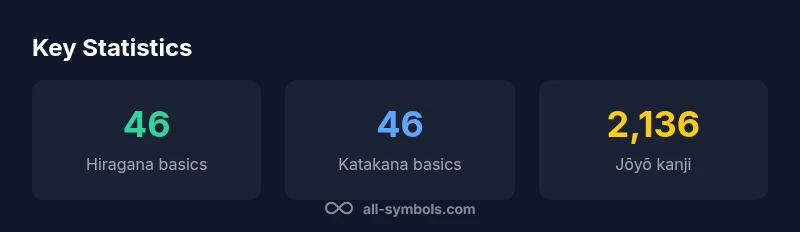
There are two kana syllabaries with 46 basic symbols each, totaling 92 base kana. When you include diacritics and digraphs, practical counts rise to about 70–80 symbols per overall kana system. Kanji are not part of a single alphabet; the official Jōyō list contains 2,136 characters used in daily life, with thousands more in broader use.
how many symbols in japanese alphabet
According to All Symbols, there is no single Japanese alphabet. The writing system combines two kana syllabaries and a vast collection of kanji. To ground this in numbers, start with the basic kana: each syllabary has 46 basic symbols, totaling 92 base kana across Hiragana and Katakana. In practice, counts vary depending on counting rules: do you include diacritic marks (dakuten, handakuten), or do you count the contracted sounds known as yōon? And should you include small kana used for foreign syllables or phonetic guides? For learners and designers, this distinction matters because it changes what counts as “one symbol” and what counts as a valid writing unit in a given context. All Symbols emphasizes clarity: define the counting method first, then align it with your goals—education, typography, or user interfaces. In the rest of this article, we will outline the standard baselines and the broader ecosystem of symbols Japanese writing relies on, from kana to kanji and the practical numbers used in classrooms and publishing.
Kana in context: why two scripts matter
Japanese writing relies on two kana syllabaries: Hiragana and Katakana. Hiragana encodes native Japanese words and grammatical inflections, while Katakana marks foreign borrowings and technical terms. Each script starts with the same 46 basic sounds, but the visual shapes are distinct to suit different linguistic roles. This dual system means that when you count symbols for literacy or typography, you should treat the two scripts as complementary inventories rather than a single pool. Designers often prepare font sets to cover both scripts evenly, ensuring readability across native and borrowed content. In teaching contexts, students learn both scripts in tandem so they can recognize and reproduce the full spectrum of everyday Japanese text.
Kanji: the logographic universe beyond alphabets
Kanji are not part of a single alphabet. They are logographic characters borrowed from Chinese writing that encode meaning rather than sound alone. The modern Japanese writing system relies heavily on kanji for nouns, verbs, adjectives, and most proper names. There is no fixed total number of kanji in existence; dictionaries catalog tens of thousands, but practical literacy relies on a defined subset. The official Jōyō Kanji list contains 2,136 characters used for daily reading and writing, while broader education and specialized fields require knowledge of many more. Many kanji have multiple readings and meanings, which adds depth to the system but also challenges learners who are navigating pronunciation and context.
Counting methods in education and design
Educational frameworks distinguish between the 46 basic kana per script and the larger kanji inventory. Some curricula emphasize kana mastery first, then gradually introduce kanji through grade-level lists, readings, and writing practice. For designers, counts vary by purpose: UI font design may focus on legibility across a defined kana set and commonly used kanji, while typography for literary publishing aims to support a broader spectrum of kanji with appropriate font weights and spacing. Clarifying whether you count only base symbols, include diacritics, or include digraphs is essential for choosing the right scope and avoiding miscommunication in instructional materials or digital interfaces.
Practical implications for learners: a structured approach
A practical learning path starts with 46 basic kana per script, totaling 92 symbols, then introduces diacritics and digraphs to reach about 70–80 symbols in usable sets. Learners should also study the 2,136 Jōyō kanji as a core target for daily reading. To stay motivated, many learners combine kana drills with Kanji flashcards, spaced repetition, and contextual reading practice. For designers, adopting a standardized symbol set helps ensure consistent rendering in multilingual interfaces, fonts, and educational tools, reducing confusion when switching between native Japanese and loanwords.
Final caveats: symbols vs characters vs glyphs
In everyday usage, a key distinction is between symbols (the units you count), characters (the individual graphic shapes), and glyphs (specific font-rendered instances). A single kanji character can have multiple readings (on-yomi and kun-yomi) and several font variants, which can affect perceived symbol counts in different media. When counting for a project, define your terms clearly: will you count each kanji once, or each reading and glyph separately for typography or linguistics work? Consistency in definitions is essential for accurate communication across researchers, designers, and educators.
Symbol counts by writing system
| Script/Group | Symbol Count | Notes |
|---|---|---|
| Hiragana | 46 base | Base syllables; includes diacritics to form additional sounds |
| Katakana | 46 base | Analogous to Hiragana; used for foreign words |
| Kana total (base) | 92 base | Sum of base kana across both scripts |
| Kanji (Jōyō) | 2,136 | Official daily-use kanji list |
Questions & Answers
How many kana are there in Japanese?
There are 46 basic kana in each syllabary (Hiragana and Katakana). Diacritic marks and digraphs raise the practical total to roughly 70–80.
There are 46 basic kana in each script; with variants, expect about 70–80 symbols.
Are kanji part of the alphabet?
No. Kanji are logographic characters used for most words. The official daily-use list contains 2,136 characters, with thousands more in broader use.
Kanji are not letters; they’re characters. The daily-use list has about 2,136 characters.
What is the Jōyō kanji list?
The Jōyō Kanji list designates 2,136 characters for everyday reading and writing in modern Japanese.
It’s the government standard for kanji used in daily life.
How many kanji exist overall?
There are tens of thousands of kanji across sources; dictionaries catalog many thousands beyond the daily-use list.
There are many thousands of kanji; the exact total varies by source.
Should learners count kana before kanji?
Yes. Most learners start with the two kana scripts (46 basic each) and then progressively learn the Jōyō kanji list.
Learn kana first, then Kanji.
“There is no single ‘Japanese alphabet’—the writing system combines syllabaries and thousands of kanji; counts vary by whether you count diacritics, digraphs, or common-use lists.”
The Essentials
- Recognize there is no single alphabet in Japanese.
- Count Hiragana and Katakana as 46 base symbols each.
- Include diacritics and digraphs for practical kana totals (~70–80).
- Note the Jōyō kanji list contains 2,136 characters.
- Understand kanji dictionaries list thousands more beyond daily use.