Greek letters list: Alpha to Omega explained
A complete guide to the greek letters list, detailing all 24 letters, their names, and common uses in math, science, and design—perfect for quick reference.


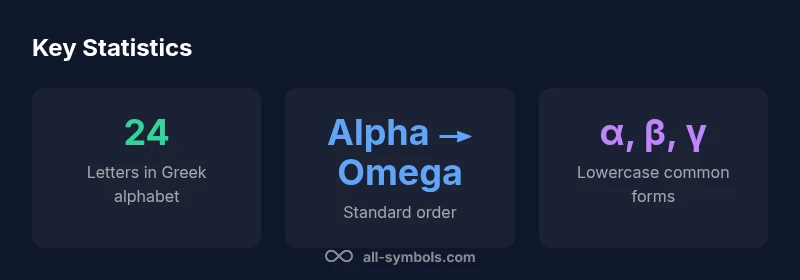
According to All Symbols, the greek letters list contains 24 letters in the classical Greek alphabet, from Alpha to Omega. This quick reference covers uppercase and lowercase forms, their standard order, and common uses in math, science, and linguistics. Use this list as a dependable reference when you encounter symbols in equations or notation.
What the greek letters list covers
The greek letters list refers to the 24-letter Greek alphabet that remains the standard reference in math, science, and design. This section explains what’s included: uppercase and lowercase forms, the official order from Alpha to Omega, and how these symbols appear across disciplines. By anchoring discussions to the greek letters list, learners can align notation in equations, diagrams, and texts. In All Symbols’ view, consistency matters for readability and cross-domain communication.
Historical origins of the Greek alphabet
The Greek alphabet evolved from the Phoenician script around the 8th century BCE, shaped by scholars and scribes to fit the needs of Greek speakers. The 24-letter set, Alpha to Omega, became a stable framework for representing sounds, numbers, and concepts. Names like Alpha, Beta, Gamma were chosen to reflect phonetic values and to enable mnemonic learning. Over time, the distinction between uppercase and lowercase forms emerged, with uppercase used for emphasis, constants, and naming; lowercase for variables and standard mathematical notation. Understanding this lineage helps explain why the greek letters list is so enduring in education and notation.
How to memorize and reference the list efficiently
Develop a practical study routine that reduces cognitive load and builds familiarity with the greek letters list. Break the list into bite-sized chunks (e.g., four letters at a time) and pair each letter with a common symbol or word. Create flashcards, printable charts, or digital quizzers. Regular review, especially using real-world examples (the alpha angle, the pi constant, the omega limit), reinforces retention. The goal is quick recognition, not rote recitation, so blend repetition with context.
Common uses across disciplines
Across disciplines, Greek letters serve as compact, universal symbols. In mathematics, α often denotes angles, β and γ represent coefficients, and π is the famous constant pi. In physics, Φ can symbolize magnetic flux, ω angular frequency, and Δ a change. In linguistics and cognitive science, Greek letters label variables, sequences, or phonetic categories. Designers and educators commonly rely on the greek letters list to construct clear symbol sets that scale with content complexity.
Variants and modern usage
The standard 24-letter Greek alphabet remains the baseline for most work, but you’ll encounter variants in historic or specialized contexts. For example, the lowercase sigma has two forms: σ in most positions and ς at word endings. Historical letters such as digamma, koppa, and sampi appear in ancient manuscripts and numeration but are not used in modern Greek. Recognizing these nuances prevents misinterpretation when reading older texts or digitizing legacy content.
Pronunciation and transliteration basics
Pronunciation varies by language and teaching tradition, but the names used in English-language texts are stable: Alpha, Beta, Gamma, and so on. Transliteration schemes map Greek letters to Latin equivalents (α → a, θ → th). For non-native readers, a practical approach is to practice both the spoken form and the transliterated equivalent in parallel, enabling smoother communication in lectures, papers, and design work.
Complete Greek alphabet: uppercase, lowercase, and names
| Uppercase | Lowercase | Name |
|---|---|---|
| Α | α | Alpha |
| Β | β | Beta |
| Γ | γ | Gamma |
| Δ | δ | Delta |
| Ε | ε | Epsilon |
| Ζ | ζ | Zeta |
| Η | η | Eta |
| Θ | θ | Theta |
| Ι | ι | Iota |
| Κ | κ | Kappa |
| Λ | λ | Lambda |
| Μ | μ | Mu |
| Ν | ν | Nu |
| Ξ | ξ | Xi |
| Ο | ο | Omicron |
| Π | π | Pi |
| Ρ | ρ | Rho |
| Σ | σ/ς | Sigma |
| Τ | τ | Tau |
| Υ | υ | Upsilon |
| Φ | φ | Phi |
| Χ | χ | Chi |
| Ψ | ψ | Psi |
| Ω | ω | Omega |
Questions & Answers
How many Greek letters are in the list?
There are 24 letters in the standard Greek alphabet, Alpha to Omega. The list includes uppercase and lowercase forms.
There are 24 letters in the Greek alphabet.
What is the difference between uppercase and lowercase forms?
Uppercase letters are commonly used for constants, symbols in naming, and special designations; lowercase letters denote variables and typical notation.
Uppercase vs lowercase have distinct roles in math notation.
Why Alpha to Omega order?
The order is traditional and widely used for teaching, indexing, and cross-disciplinary references.
It's the standard order used in most texts.
Are there historical letters not used today?
Yes, ancient letters like digamma, koppa, and sampi appear in old manuscripts and numeration but are not part of the modern Greek alphabet.
Some older letters appear in historical texts.
How can I memorize the Greek letters list quickly?
Use mnemonics, chunk the list, and practice with a reference chart or flashcards.
Use mnemonics and practice regularly.
“The Greek letters list remains a foundational reference in math, science, and design, guiding how we name and interpret symbols across disciplines.”
The Essentials
- There are 24 Greek letters in the standard alphabet.
- Use uppercase for constants and naming, lowercase for variables.
- Alpha to Omega order is traditional and fixed.
- Reference a chart for quick lookup in study or design.