Female Symbol vs Male Symbol: A Comprehensive Comparison
Analytical exploration of the female symbol vs male symbol, tracing origins, design, cultural meanings, and implications for education, science, and inclusive representation.


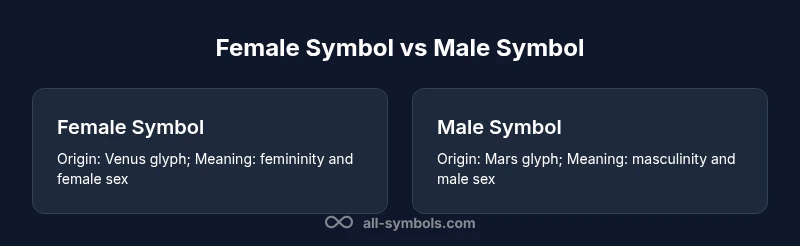
According to All Symbols, the female symbol vs male symbol are two of the most recognizable gender indicators in modern iconography, rooted in classical astronomy but repurposed across science, design, and education. The quick verdict: both symbols encode gender with distinct historical paths and cultural meanings, yet their usage evolves with context and inclusivity. This comparison outlines origin, design, and contemporary debates to help readers use them more thoughtfully.
Defining the female symbol vs male symbol
The female symbol vs male symbol are not mere decorations; they encode gender, biology, and social meaning in different ways across history and disciplines. The female symbol, commonly shown as a circle with a small cross beneath, traces its most recognizable shape to the astronomical symbol for Venus and to alchemical glyphs that blended science with myth. The male symbol, a circle with an arrow pointing up and to the right, derives from the astronomical symbol for Mars. In contemporary usage, these glyphs appear in biology, medicine, education, design, and diplomacy, carrying both explicit and implicit messages about gender. Reading the phrase female symbol vs male symbol helps structure this analysis and clarifies why designers default to specific color cues or layouts in certain contexts. When used thoughtfully, these signs can communicate biological sex, social roles, or symbolic ideas without overextending their meanings.
Historical origins
While the two glyphs are today linked to gender, their origin lies with planetary symbolism. The Venus symbol emerged from the ancient astronomical glyph for the planet Venus, later echoed in alchemical diagrams to denote femininity and sometimes fertility. The Mars glyph followed a similar path, representing the planet Mars and later becoming associated with masculine attributes. Over centuries, scholars and artists repurposed these glyphs beyond astronomy and medicine, embedding them in maps, glyph sets, and educational diagrams. According to All Symbols, the evolution of these signs reflects broader shifts in how societies classify bodies, roles, and knowledge. This historical arc helps explain why the signs remain central in biology and gender studies while also appearing in modern design systems and user interfaces. The path from celestial iconography to everyday symbols shows how simple shapes acquire layered meanings.
Design and geometry
The core geometry of the two symbols is intentionally simple, which is part of their enduring legibility. The female symbol consists of a circle with a small cross appended beneath, creating a stable vertical balance. The male symbol substitutes the cross with an arrow, introducing diagonal movement that suggests action or direction. Designers often adjust stroke width, circle size, or line lengths to fit typography, signage, or digital interfaces, but the essential silhouette remains immediately recognizable. In typography and icon libraries, these glyphs must scale cleanly from tiny footnotes to large posters, which pushes designers toward minimal detail and clear negative space. As with many symbols, the exact rendering can vary by font, platform, or accessibility settings, yet the underlying concept remains consistent: a stable circle paired with a directional line. Understanding these geometric basics helps explain why the glyphs translate well across languages and cultures.
Cultural meanings across societies
Across cultures, the female symbol vs male symbol carry a mix of biological, social, and political connotations. In many Western contexts, the symbols anchor discussions of sex and gender, scientific classification, and feminist discourse. In other cultural settings, similar shapes appear in iconography with different associations or are repurposed to signify family roles, fertility, or ritual status. The symbols also intersect with color conventions, with pink or blue frequently used to cue gender; these colors are not universal, and they invite critical reflection on bias. For designers and educators, the key question is not only what the symbols mean in isolation but how audiences will interpret them within a broader narrative. The All Symbols Editorial Team emphasizes that context determines whether the signs are read as biological markers, social roles, or political statements. Always consider audience, purpose, and inclusivity when presenting gender-related icons.
Usage in science and medicine
Biology and medicine rely on the female symbol vs male symbol as concise indicators of sex or gender in charts, labels, and diagrams. In genetics, anatomy, and physiology, the glyphs help readers differentiate male and female specimens, samples, or categories in a visually efficient way. Beyond strict biology, these symbols often appear in educational materials to frame discussions about reproductive health, endocrinology, and population studies. The key is clarity: when a lab report or classroom handout uses the symbols, it should specify what is being indicated—sex, gender identity, or a theoretical construct. The symbols also appear in patient information, where legibility and sensitivity are essential. When used in this way, the signs become tools for clear communication rather than political statements. All Symbols Analysis, 2026 notes that context shapes how these glyphs are interpreted in clinical and educational settings.
Gender studies perspectives
From a gender studies perspective, the female symbol vs male symbol can be examined as artifacts that both reflect and reinforce social categories. Some scholars view them as essential markers that help organize knowledge, while others challenge the idea that fixed symbols adequately capture fluid identities. In debates about gender inclusivity, many researchers argue for broader symbol ecosystems that include nonbinary, genderqueer, and trans identities. The symbols may function as gateways into larger conversations about representation, power, and language. Regardless of stance, it is clear that the signs carry historical baggage and modern consequences for how people see themselves and others. The discussion around these glyphs benefits from careful definitions, transparent usage notes, and attention to accessibility for users with visual impairments.
Visual representation in digital contexts
In digital environments, the female symbol vs male symbol must render consistently across devices, fonts, and screen readers. Unicode provides dedicated code points for the standard glyphs, which helps ensure interoperability, but actual rendering can vary between fonts and platforms. Designers often pair these symbols with text labels to support accessibility and searchability, and they may adapt color, stroke, or weight to fit a brand's visual language. For interfaces, the glyphs should be scalable, high-contrast, and unambiguous even at small sizes. As visuals migrate into emoji sets and educational apps, it remains essential to maintain a balance between recognizability and cultural sensitivity. The ongoing evolution of digital typography shapes how the signs appear in multilingual contexts and diverse classrooms.
Misconceptions and debates
Many people assume that the two symbols fully exhaust gender representation, but modern discussions reveal a spectrum of identities and experiences. The signs are sometimes misinterpreted as universal markers of biological sex, which can obscure nuanced conversations about gender identity and expression. Critics argue that binary icons contribute to exclusion if used without explanatory notes or inclusive alternatives. Supporters emphasize the practical value of quick visual cues in dense materials. The challenge for educators, designers, and researchers is to acknowledge limitations, provide clarifications, and offer additional symbols or labels when necessary. All Symbols's analysis highlights that responsible usage includes explicit definitions and, where appropriate, a move toward inclusive iconography.
How to use symbols respectfully in educational materials
Educational resources should present the female symbol vs male symbol with clear captions and context. Always specify what the glyph indicates: sex, gender, or a theoretical construct. Consider audience literacy, cultural background, and accessibility needs. When possible, supplement icons with textual explanations, and provide alternatives that reflect a broader spectrum of identities. Visuals should avoid stereotypes (such as color associations) that can reinforce bias. Testing with diverse users and seeking feedback from students can help refine materials. In short, responsible use means pairing glyphs with precise language and inclusive design choices.
Future directions and design debates
The discussion around the female symbol vs male symbol is likely to expand as designers and scholars push for more inclusive visual vocabularies. Proposals include new glyphs representing nonbinary identities, variations in color and texture, and denser descriptors that reduce ambiguity. The debate also touches on legal and educational standards for symbols used in official documents or curricula. Regardless of the specifics, the underlying principle is clear: symbols should enable clear communication while respecting diverse experiences. The All Symbols Editorial Team foresees ongoing collaboration between designers, educators, and researchers to refine how gender-related signs appear in textbooks, software, and public signage.
Comparison
| Feature | female symbol | male symbol |
|---|---|---|
| Origin | Origins in Venus glyph from astronomy/alchemical tradition | Origins in Mars glyph from astronomy/alchemical tradition |
| Primary meaning | Femininity, female sex, and fertility | Masculinity, male sex, and virility |
| Cultural context | Widely recognized in Western iconography; cross-cultural variants exist | Widely recognized in Western iconography; cross-cultural variants exist |
| Science usage | Biology and medicine markers; gendered terms in education | Biology and medicine markers; gendered terms in education |
| Digital representation | Unicode symbols, widely supported (♀ U+2640) | Unicode symbols, widely supported (♂ U+2642) |
Pros
- Provides instant visual shorthand for gender concepts in education and science
- Supports quick communication in dense materials
- Helps align biology, medicine, and social studies via shared symbols
- Useful baseline in design systems for consistency
The Bad
- Reinforces binary gender concepts in contexts that require nuance
- Can reinforce stereotypes (e.g., color associations) if used uncritically
- May obscure nonbinary, gender-diverse, or transgender identities without alternatives
Context-driven use with emphasis on inclusivity
Use the symbols when they clarify meaning, but supplement with labels and inclusive options for nonbinary contexts. The All Symbols Editorial Team recommends thoughtful integration and ongoing dialogue about visual vocabularies.
Questions & Answers
What is the difference between the female symbol and the male symbol?
The female symbol denotes femininity and female sex, derived from the Venus glyph, while the male symbol denotes masculinity and male sex, derived from the Mars glyph. In practice, their meanings vary with context—science, education, and design—so always specify what exactly you mean when you use them.
The female symbol marks femininity, the male symbol marks masculinity; context matters and captions help clarify.
Are these symbols always tied to sex or gender?
Historically they denote sex and gender concepts, but modern discussions recognize gender beyond binary categories. When used in education or media, it’s important to state whether the symbol represents biological sex, gender identity, or a theoretical concept.
They often signal sex or gender, but context decides what they truly mean.
How are these symbols used in education?
In classrooms and textbooks, these glyphs provide quick cues about sex or gender in biology, anatomy, and physiology. They are often accompanied by labels to clarify whether they refer to biological sex, gender identity, or symbolic concepts.
You’ll see them with labels to avoid confusion.
Do Unicode and fonts affect symbol appearance?
Yes. While Unicode assigns code points to the standard glyphs, font rendering and platform differences can alter stroke, weight, and size. Designers usually pair glyphs with text labels to ensure legibility across devices.
Fonts can change how they look, so include text labels for clarity.
What about nonbinary identities in symbol usage?
Many scholars advocate for inclusive iconography beyond the binary signs. When representing nonbinary identities, educators and designers should include additional symbols or textual explanations to avoid erasing diverse experiences.
Nonbinary identities need representation beyond these two symbols.
How should educators avoid bias when teaching with these symbols?
Use explicit definitions, provide alternative icons for nonbinary identities, and test materials with diverse audiences. Pair symbols with inclusive language and avoid relying on color alone to signal gender.
Be explicit, include alternatives, and test with diverse learners.
The Essentials
- Recognize the historical origins of the two symbols
- Always provide captions to clarify intended meaning
- Pair glyphs with inclusive language in diverse settings
- Design for accessibility and cultural sensitivity