Can you get a character after C6? A practical guide to hex, Unicode, and encoding
Explore what comes after C6 in hex and Unicode, the next character Ç (U+00C7), and practical encoding notes for developers and designers.


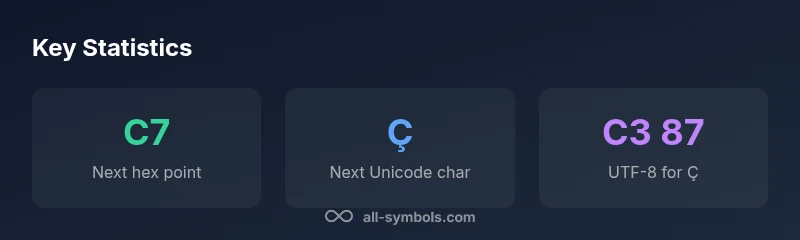
Yes. When counting hexadecimal code points, the value after C6 is C7, and the corresponding character at U+00C7 is Ç. In Unicode, the sequence around C6 runs from Æ (U+00C6) to Ç (U+00C7). In UTF-8, Ç is encoded as the two-byte sequence C3 87. Understanding these encodings helps you reliably map hex values to symbols across platforms.
Can you get a character after c6? Practical framing
If you’re debugging text rendering or dealing with hex code points, you might ask: can you get a character after c6? The short answer is yes, but the full answer depends on the encoding. According to All Symbols, the next code point after C6 is C7 in hex, which corresponds to Ç in Unicode (U+00C7). This distinction matters for developers who work with data interchange, fonts, and scripting languages. Throughout this article we’ll unpack what the phrase can you get a character after c6 means in practical terms, and how to reliably map hex values to symbols across common encodings.
Hex, Unicode, and encoding basics
Hex is a base-16 notation used to express code points, bytes, and memory addresses. In Unicode, each character is identified by a code point like U+00C6 for Æ or U+00C7 for Ç. When you advance by one in hex from C6, you reach C7; in Unicode terms this is U+00C7. The encoding you choose (ASCII, ISO-8859-1 Latin-1, UTF-8, UTF-16) determines how that code point maps to bytes on disk or in transit. For most modern systems, the same code point yields the same symbol, but the byte representation differs by encoding. If you are comparing encodings, remember that some legacy systems don't support all code points, which complicates the mapping can you get a character after c6 across platforms.
The concrete next character after C6
In the standard Latin-1 and Unicode spaces, advancing from C6 lands on C7. The actual character is Ç (Latin Capital Letter C with Cedilla), which is U+00C7 in Unicode terminology. In practical terms, if your data uses Latin-1 or Unicode conventions, the next symbol you’ll encounter after C6 is Ç. If you are working with case-insensitive searches or string normalization, you’ll want to account for this variation as you move between code points, bytes, and display layers. This is especially important for internationalization, fonts, and user interfaces.
How to compute the next code point in code
- In Python:
- next_cp = chr(ord('\u00C6') + 1) # yields 'Ç'
- print(next_cp) # Ç
- In JavaScript:
- const nextChar = String.fromCodePoint('\u00C6'.codePointAt(0) + 1);
- console.log(nextChar); // Ç
These examples show how a simple arithmetic step in the code point space maps directly to a real character. If you’re dealing with arbitrary hex values, a robust approach is to convert to the integer code point, add one, and then re-plot to a character with chr/fromCodePoint equivalents in your language of choice.
Practical implications for fonts, rendering, and sorting
- Fonts: Ensure your font coverage includes Ç to avoid missing glyphs. Some web fonts may not include cedilla variants, leading to tofu boxes.
- Rendering: Some rendering engines treat precomposed vs. decomposed forms differently. Normalization (NFC vs NFD) can influence display consistency when you switch encodings.
- Sorting: Collation rules may differ by locale. In some locales, diacritic marks affect order, so a simple hex increment may not align with human expectations.
- Data interchange: When exchanging data between systems with different default encodings, validate that the receiver interprets C7 as Ç and not as some placeholder or error symbol.
Common pitfalls and edge cases
- Encoding mismatch: Treat C6 as a code point, not a byte; in encodings that don’t include 0xC6, you may see replacement characters.
- Case handling: Hex arithmetic is agnostic to case in display, but always confirm the actual code point when parsing input.
- Multibyte encodings: In UTF-8, U+00C7 maps to bytes C3 87; if you only inspect the first byte, you’ll misinterpret. Always decode fully before displaying or transforming.
- Normalization: If you store characters in decomposed form, you may need normalization to ensure canonical equality when comparing after conversion.
Quick reference cheat sheet: can you get a character after c6?
- Hex step: C6 -> C7
- Unicode: U+00C6 -> U+00C7; character: Ç
- UTF-8: Ç -> C3 87
- Practical rule: always verify encoding context before mapping codes to symbols
Comparison of the next-character representation after C6 across encodings
| Encoding | Code Point | Next Character | Notes |
|---|---|---|---|
| Latin-1 (ISO-8859-1) | 0xC6 | Ç | Next code point after C6 in ISO-8859-1 |
| Unicode (U+00C6) | U+00C6 | U+00C7 | Next code point in Unicode sequence |
| UTF-8 encoding for Ç (U+00C7) | U+00C7 | Ç | UTF-8 bytes for next code point (C3 87) |
Questions & Answers
What does it mean to say 'after C6' in hex?
It means increasing the hexadecimal value by one, resulting in C7. In Unicode this corresponds to U+00C7, which is the character Ç. The exact byte representation depends on the encoding you’re using, so always verify the target encoding when moving between hex, code points, and bytes.
It means adding one to the hex code, so C7 and the character Ç show up, depending on encoding.
Is Ç always the next character after C6?
In common encodings like ISO-8859-1 and Unicode, yes—the next code point after C6 is Ç (U+00C7). However, certain legacy or custom encodings might map values differently, so check the encoding map when in doubt.
Usually yes, but always confirm the encoding.
How is Ç encoded in UTF-8?
Ç (U+00C7) encodes to the two-byte sequence C3 87 in UTF-8. When decoding, that sequence should map back to the single character Ç.
Ç uses two bytes in UTF-8: C3 87.
What about case when counting hex in different bases?
Hex counting is case-insensitive for the numeric value (C6 equals c6). When translating to characters, always rely on the code point value, not the letter case of the hex digits.
Hex letters don’t change the value; use code points to map to characters.
How can I programmatically find the next character after a given code point in Python?
Convert to an integer code point with ord(), add 1, then convert back with chr(). For example, chr(ord('\u00C6') + 1) returns 'Ç'.
In Python, just do ord + 1 and then chr.
“Encoding is about aligning code points, not just bytes. A one-step hex advance from C6 becomes Ç in Unicode, provided you’re in a compatible encoding.”
The Essentials
- Count hex increments carefully; C6 → C7
- Unicode moves from U+00C6 to U+00C7, Ç
- UTF-8 encodes Ç as C3 87
- Always verify encoding context before mapping codes