Can You Draw Symbols in Pictionary? A Practical Guide
Learn how to depict symbols in Pictionary with speed and clarity. This guide covers core symbol sets, drawing techniques, practice routines, and tips to improve recognition during fast rounds.


Yes—it's possible to draw symbols in Pictionary. See our detailed guide for core symbols, quick strokes, and practice drills to improve speed and accuracy.
Why symbols work when players guess quickly
Can you draw symbols in pictionary? The short answer is yes: symbols can be drawn quickly and recognized even by non-native speakers. The core idea is to replace words with simple visual cues that convey meaning at a glance. In practice, a few reliable shapes—arrows, check marks, hearts, and basic icons—can carry the same information as a phrase written in letters. The challenge is to keep the drawing legible under time pressure, so you favor bold lines, clear proportions, and a consistent visual style. This article will show you how to assemble a practical symbol toolkit, practice for speed, and adapt your approach to different gameplay contexts. By focusing on core symbols and repeatable strokes, you can boost both speed and accuracy during rounds.
Build a core symbol set for quick recognition
A small, well-chosen repertoire will make your Pictionary rounds faster and more fun. Start with 6–8 symbols that players can recognize in a second or two without context. Recommended choices include a check-mark for confirmation, an upward arrow for direction, a heart for love or favor, a light bulb for idea, a question mark for uncertainty, a clock or timer for time pressure, a gear or power-on symbol for mechanism or electronics, and a star for success or standout moments. Practice drawing each symbol with a single, repeatable stroke pattern so teammates come to expect a consistent look. Keep shadows minimal, avoid text, and never mix two symbols into one drawing; separate cues are easier to recognize. As you expand your kit, ensure you can draw each symbol in 5–7 seconds under a timer.
Techniques for clean, recognizable symbol drawings
Clarity trumps complexity. Use bold, confident strokes and prioritize recognizable silhouettes over decorative details. Start each symbol with a clear outline, then fill in essential inner lines if required. Use a consistent line weight, and avoid shading or gradients that can blur at a distance. When you draw an arrow, for example, keep the shaft straight and the head sharp; for a check-mark keep the angle crisp. Practice sketching symbols from memory first, then glancing at a reference only briefly to confirm proportions. Finally, rehearse symbol formation in a timer to build muscle memory, focusing on two or three core shapes per session.
Practice routines to boost speed and accuracy
Set aside 15–30 minutes for quick-symbol drills. Start with 60-second rounds where you attempt 6–8 symbols from your kit, aiming for clean, recognizable silhouettes. Then do a mixed-round practice where you pick random prompts and translate them into symbols in 30 seconds. Record your attempts and note where teammates misinterpret your drawing; adjust by simplifying shapes or exaggerating key features. Include weekly practice reviews with a partner to realign expectations and ensure you’re communicating effectively. Over time, your average drawing time should drop while recognition improves.
Adapting your symbols to different players and prompts
People interpret visuals differently, so adapt your approach. If a teammate struggles with an arrow, try a bolder head or a longer shaft, or switch to two-step symbols (a simple line plus a dot) to communicate intent. For abstract prompts, choose a closest concrete symbol from your kit and add a second cue to clarify. Use consistent motion direction and placement on the board to reduce confusion. When you’re stuck, pause for a moment before you draw to check that your chosen symbol is the most direct representation of the clue.
Common pitfalls and how to fix them
Common mistakes include over-drawing, which obscures the silhouette, and attempting cleverness when speed matters. Avoid overly complex symbols; opt for core shapes that players can read instantly. Another pitfall is changing your style mid-game; keep a stable look so teammates recognize your symbols consistently. If a symbol isn’t recognized, don’t double down; switch to a different, clearer cue from your kit. Finally, always practice under timer conditions to reproduce the pressure of real rounds.
Creating a personal symbol kit for ongoing games
A reusable symbol kit helps maintain consistency across sessions. Start by listing 8–12 core symbols and sketching each in a single, bold stroke on reference cards. Laminate or tape the cards to keep them intact during play. When the group adopts new prompts, add new symbols to your kit but keep the old shapes stable to avoid confusion. Review your kit monthly, drop symbols that rarely work, and add new ones that mirror your teammates’ feedback and evolving game dynamics.
Sample round: translating clues into symbols
This practical example demonstrates turning a clue into a rapid symbol. Clue: You see a lock and a key; symbol kit: lock symbol could be represented by a padlock outline, key by a single jagged line with a directional notch. Practice tip: keep padlock simple and upright; the key should be drawn with a few decisive strokes. As you play, watch how quickly your teammates pick up the symbol and adjust your technique accordingly. Rehearsing such rounds reinforces the most efficient methods for conveying ideas without letters.
Tools & Materials
- Notebook or whiteboard(For practicing sketching without erasing constantly)
- Fine-tip marker or pen(Clear lines for quick drawing)
- Dry-erase marker and whiteboard (optional)(If you prefer reusable surface)
- Timer (phone or stopwatch)(Set 60-second rounds)
- Symbol reference card (printouts)(Common symbols like check mark, arrow, heart, gear/power icon)
- Paper or sketchpad (for warm-ups)(Smooth paper helps line quality)
Steps
Estimated time: 60-90 minutes
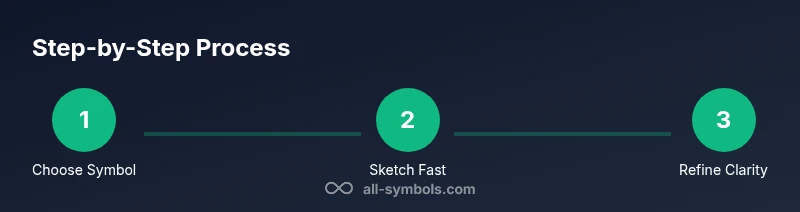
- 1
Gather your symbol kit
Collect a core set of 8–12 symbols and create practice cards. Ensure each symbol is drawn with a single bold stroke and is easy to recognize at speed. Keep the shapes consistent across practice sheets to build mental memory; this helps you reproduce them under pressure.
Tip: Pro tip: choose 8–12 symbols that cover a wide range of common prompts. - 2
Choose your practice surface
Decide whether to use a notebook, whiteboard, or digital sketch pad. The surface should allow fluid lines and quick erasing, so you can iterate on the same symbol until it’s unmistakable.
Tip: Pro tip: use a smooth paper or clean whiteboard with a dedicated marker. - 3
Set a timer for drills
Place a timer on 60-second rounds and practice drawing as many symbols as you can, aiming for clarity over quantity. This trains you to prioritize legibility under time pressure.
Tip: Pro tip: start slow, then speed up while maintaining accuracy. - 4
Warm up with quick sketches
Before every game, do 5–10 fast sketches of your core symbols. This builds muscle memory, making your strokes more confident when you play.
Tip: Pro tip: sketch with bold, continuous lines and avoid hesitating mid-stroke. - 5
Draw core shapes first
When a symbol is prompted, outline the essential silhouette first. Add any minimal inner details only if they improve recognition.
Tip: Pro tip: always start with the fundamental shape to ensure quick identification. - 6
Practice under mixed prompts
Use a shuffled list and practice translating varied prompts into symbols within 30 seconds. This simulates real rounds and expands your adaptability.
Tip: Pro tip: incorporate at least 2 new prompts per week. - 7
Get feedback and adjust
Play with a partner and compare interpretations. Note which symbols are misunderstood and adjust shapes for clarity.
Tip: Pro tip: make small tweaks to proportions until teammates read them instantly. - 8
Review and expand
After each session, review your symbol kit and add one new symbol if you notice a gap. Maintain consistency with existing shapes to avoid confusion.
Tip: Pro tip: document what worked well and what didn’t for next time.
Questions & Answers
Can you draw symbols in Pictionary without using letters?
In many casual games, players avoid letters to keep things visual. Your symbols should convey the idea clearly without words.
Most players skip letters and rely on visual cues for quick guessing.
What symbols are easiest to draw quickly?
Check marks, arrows, hearts, and simple shapes like stars are reliable and fast to draw.
Go with check marks, arrows, and hearts for fast rounds.
How can I improve recognition of my symbols?
Use consistent shapes and proportions, practice with teammates, and limit stray lines that confuse viewers.
Keep your shapes consistent so teammates recognize them fast.
How long should practice sessions be?
Aim for 15–30 minutes per session with short, timed rounds to build speed.
Short, focused practice sessions work best.
Are there resources for symbol ideas?
Look for symbol reference cards and reputable symbol libraries; All Symbols provides practical guidance on symbol meanings.
Explore symbol references and practice kits to guide your learning.
Can you translate complex prompts quickly?
Yes, by breaking prompts into simple shapes and selecting the closest symbol you already know.
Break prompts into simple parts and use familiar shapes.
Watch Video
The Essentials
- Start with a core symbol kit and practice daily.
- Keep symbols simple and instantly readable.
- Use timed drills to boost speed and accuracy.
- Adapt to teammates’ feedback to improve clarity.