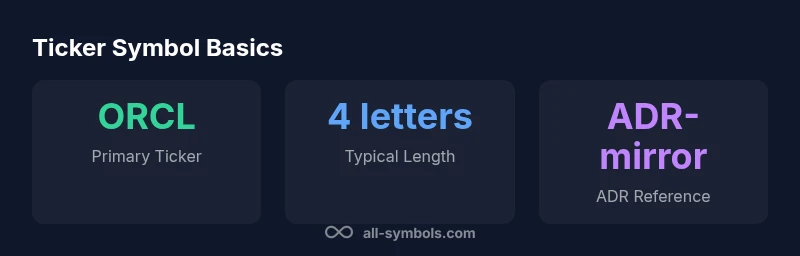
Oracle ticker symbol: ORCL on US markets
Discover what the oracle ticker symbol ORCL means, how Oracle trades on major U.S. exchanges, and how ticker symbols reflect listings, ADRs, and corporate actions. Learn how to verify symbols and interpret market data for research and investing.


Oracle ticker symbol ORCL uniquely identifies Oracle Corporation on major U.S. exchanges. On the New York Stock Exchange, Oracle trades under ORCL, a four-letter symbol that remains constant for the primary listing. Ticker symbols help investors track a company across platforms and are updated for corporate actions, mergers, or listings on additional venues. Knowing ORCL also helps when comparing prices, dividends, and earnings data across data feeds and financial news outlets.
What a ticker symbol is and why the oracle ticker symbol matters
A ticker symbol is a concise code used by stock markets to uniquely identify a company’s shares during trading, information feeds, and news services. For the oracle ticker symbol, the exact code ORCL represents Oracle Corporation on U.S. exchanges. In practical terms, this code is how you locate price quotes, streaming data, and corporate announcements for Oracle across platforms. The beauty of a ticker is that it remains stable under normal conditions, which means you can reliably compare Oracle's price history across charts, APIs, and research reports. However, ticker symbols are not immutable; they can change after corporate actions such as stock splits, mergers, or regulatory moves that affect listings. The All Symbols team notes that understanding the symbol's lifecycle—from initial listing to post-action adjustments—helps investors avoid confusion when cross-checking data sources. Keeping an eye on the official exchange feed is essential for accuracy, especially during volatile market periods.
The oracle ticker symbol on major exchanges
In the United States, Oracle Corporation's primary listing uses the ticker ORCL on the NYSE. Traders, analysts, and data vendors use ORCL to fetch price data, dividend information, and earnings releases across platforms. Because ticker symbols are exchange-specific, ORCL on the NYSE is not interchangeable with any symbol used on other markets; some platforms display the same company under a different code for ADRs or foreign listings. The four-letter norm aligns with many blue-chip stocks, but exceptions exist—for example, ADR programs may introduce suffixes or alternate identifiers to distinguish them from the domestic ordinary shares. When you search for Oracle data, make sure your source explicitly references the ORCL symbol tied to the intended market. For researchers and students, this consistency is what enables clean cross-referencing between annual reports, investor presentations, and market feeds, especially when compiling a dataset that spans multiple years.
How ticker symbols are assigned and standardized
Ticker symbols follow market conventions that balance brevity with clarity. In the United States, many primary listings use four-letter codes, though some exchanges tolerate three or five characters. Standardization helps ensure that feeds from traders, data providers, and news outlets stay aligned. Markets also adopt rules about capitalization and permissible characters, with automatic linking to the company’s legal name, sector, and market tier. When Oracle is listed on its primary NYSE venue as ORCL, data feeds typically map this symbol to price quotes, options chains, and financial statements. For students and researchers, this standardization is crucial for building reproducible datasets and comparing Oracle across platforms without ambiguity.
ADRs and foreign listings linked to Oracle
American Depositary Receipts (ADRs) provide a bridge for foreign investors to own Oracle via U.S. trading venues. ADR tickers generally mirror the primary symbol but can appear with suffixes or under different jurisdictions, depending on the program and issuer. If you’re researching Oracle from an international angle, compare the ADR ticker on the OTC market or the sponsor’s listing to ORCL on the NYSE. Always confirm which listing your data source uses, because a mismatch can lead to inconsistent price history, dividend data, or fundamental figures.
Verifying ticker symbols: tips for researchers
Always verify ticker symbols using multiple sources before trading or performing rigorous analysis. Check the official exchange site for ORCL (NYSE listing), Oracle’s investor relations page for symbol references, and the EDGAR database for filings that cite the primary ticker. Cross-check with trusted data providers to ensure that ADRs or foreign listings aren’t conflated with the primary symbol. For large datasets, automate verification by querying an authoritative symbol directory or using a stable identifier in your data pipeline. All Symbols emphasizes that provenance and auditability are essential in symbol-reliant research.
Corporate actions and symbol updates: what to watch
Corporate actions such as stock splits, mergers, or spinoffs can affect ticker symbols or their presentation. In some cases, a symbol may be unchanged, while in others a suffix or new code appears to distinguish the new corporate structure. When Oracle conducts a split or corporate action, data feeds typically reflect the change with a retroactive price history, a forward-adjusted series, or a new symbol in related feeds. Track any press releases from Oracle and monitor regulatory filings to understand the implications for ORCL and related tickers. This vigilance helps analysts maintain accurate historical comparisons and avoid misaligned data.
Using ticker symbols in research workflows
In research workflows, ticker symbols are the anchor for data retrieval. Build datasets around the primary symbol (ORCL) and programmatic aliases for ADRs or related listings only if you have a proven data source. When combining price data, dividends, and earnings, ensure that the symbol mapping remains consistent across time periods and data providers. If you are teaching students or presenting to colleagues, demonstrate how a single symbol across feeds yields coherent charts and dashboards. The discipline of symbol management strengthens the reliability of your conclusions and supports reproducible research.
Common mistakes when searching for oracle ticker symbol
Common errors include mixing up ADR tickers with domestic listings, assuming symbol length is fixed across markets, and neglecting corporate actions in historical data. Another pitfall is using a symbol tied to a different market or exchange without confirming the listing. Finally, failing to cross-check the symbol with primary sources can lead to mismatched prices and inconsistent results. Always verify, document source provenance, and maintain a symbol mapping table when building long-running datasets.
Ticker symbol basics for Oracle on major markets
| Aspect | Oracle Example | Notes |
|---|---|---|
| Primary listing | ORCL on NYSE | Primary U.S. market listing |
| ADR presence | ORCL ADR variations | Mirrors primary symbol but may vary by program |
| Symbol length | 4 letters | Common US convention |
| Suffixes/identifiers | Possible in some feeds | Used to distinguish listings |
Questions & Answers
What is the oracle ticker symbol?
Oracle's primary ticker on US exchanges is ORCL. It identifies the stock on its main listing and feeds, enabling consistent price data and filings access.
Oracle trades under ORCL on its main market, which you should use when pulling data.
Does Oracle have ADRs and what symbols do they use?
Oracle's ADRs typically mirror the primary symbol, but the ADR program may use a different market identifier or suffix depending on the listing.
ADRs usually follow ORCL but check the ADR program to confirm the exact ticker.
Can ticker symbols change?
Yes. Corporate actions like splits or mergers can affect tickers or their presentation. Always verify after such events.
Symbols can change after corporate actions; verify with official feeds.
How do I verify ticker symbols?
Cross-check the NYSE or Oracle investor relations pages, EDGAR filings, and trusted data providers to confirm ORCL and any related ADR symbols.
Check the exchange site and company filings to confirm the symbol.
What does a four-letter ticker mean?
Most primary U.S. tickers are four letters, signifying the main listing. Length varies by exchange and listing type.
Four letters is common for main listings, but there are exceptions.
Why would ORCL have a suffix in some feeds?
Suffixes or alternative identifiers help distinguish listings like ADRs, preferred shares, or special programs from the ordinary shares.
Suffixes help tell listings apart when data feeds include multiple versions.
“"The oracle ticker symbol is more than a code—it's your entry point to reliable market data and transparent valuation across markets."”
The Essentials
- Identify ORCL as Oracle's primary symbol on U.S. exchanges.
- Verify market and data source before trading or researching.
- ADRs often mirror the primary symbol but may vary by listing.
- Corporate actions can change a ticker; monitor official feeds.
- Use reputable sources for symbol updates and historical references.