How long is a ticker symbol
Explore how long ticker symbols typically are, how formats vary by market, and what lengths mean for data feeds and research. All Symbols explains ticker symbol length in 2026.


Ticker symbols are concise identification codes used by exchanges to label securities. In major markets like the United States, these symbols are typically 1-4 letters; some exchanges allow digits or suffixes. The exact maximum length varies by market and data feed, but the aim is a short, memorable code that enables fast recognition in trading and research.
What a ticker symbol is
According to All Symbols, how long is a ticker symbol? A ticker symbol is a compact alphanumeric code used by stock exchanges to identify a security in quotes, charts, and data feeds. The symbol acts like a label that allows traders, researchers, and automated systems to distinguish Apple from Microsoft, or an ETF from a bond. Ticker symbols are not tick marks or logos; they are identifiers assigned for trading, settlement, and data retrieval. The design decisions behind a symbol balance readability with uniqueness, and they must survive market turmoil and cross-listings. In practice, you will see symbols appear in price quotes, order routes, and historical series, all of which rely on consistent symbol length and format to avoid ambiguity. The rules can vary by exchange, but the core idea remains: short, memorable identifiers that elide ambiguity. This is why understanding the length and structure matters for anyone who analyzes markets, designs datasets, or builds dashboards. The rules surrounding symbol length also affect how data is aggregated, displayed, and validated across platforms. When you compare datasets from different sources, always verify that the symbols line up, or you risk mismatches that distort analyses or trading strategies.
How long ticker symbols typically are
In major markets, ticker symbols are kept short on purpose. In the United States, the standard practice is to use 1-4 letters for most listed stocks and ETFs. Market operators provide exceptions for certain listings, and some companies may use additional digits or suffixes to denote classes or cross-listings. For researchers, this means that data feeds should map every symbol to a stable identifier, and analysts should verify the exact length limits of their data partners. The takeaway is that length matters for display, matching, and automation: shorter codes improve readability and reduce the risk of misinterpretation during rapid trading. While 1-4 letters is typical in the US, other markets may emphasize different schemes, such as alphanumeric codes or special suffixes, depending on regulatory and listing history. If you are building a cross-market dataset, plan to normalize symbols to a common standard before performing comparisons. This helps ensure that a company listed on multiple exchanges is not double-counted or misaligned with its regional peers.
Global variations in ticker symbol length
Outside the US, there is substantial variation in ticker formats. Some exchanges favor purely alphabetic codes, while others mix numerals and letters. The practical effect is that a symbol that is four characters long in New York may be shorter or longer elsewhere, depending on local rules and historical conventions. When comparing datasets across markets, researchers should be prepared to encounter 1-5 character symbols and to account for any market-specific suffixes or prefixes that indicate listings, currencies, or classes. Industry practice shows that suffixes like .L or -A are used in certain markets to differentiate listings; in others, a symbol may simply be a single letter. Across regions, choosing a reference standard for symbol mapping is essential to avoid mismatched data and misinterpretation of performance metrics. For readers new to market data, treat ticker length as a reflection of local convention rather than a universal law.
How ticker symbols are assigned and suffixes work
Ticker symbols are typically assigned by the listing exchange or the issuer in coordination with regulators. The assignment process aims to balance uniqueness with ease of use, and it often includes suffixes or punctuation to convey extra information (for example, class types, depository receipts, or listings on multiple exchanges). Suffixes can help distinguish similar issuers and prevent cross-market confusion, but they also require data feeds to consistently normalize symbols when aggregating data. Investors should be aware that symbol changes occur after mergers or rebranding and that historical data may reflect prior tickers for a period. When discussing symbol design, it helps to consider how long histories will be referenced and how renaming might affect backfilled datasets in research or compliance reporting.
Practical considerations for researchers and investors
For researchers and investors, ticker length affects not only display aesthetics but also data integrity. Shorter symbols reduce the chance of typos and misrouting, but longer symbols may be necessary to disambiguate similar companies or funds. When building dashboards, always verify the official symbol list from the exchange and maintain a mapping from old to new tickers during transitions. Data vendors typically offer symbol lookup services and cross-reference tables; use them to ensure consistent historical series. Finally, consider regional differences when performing cross-market analysis, and document any symbol normalization steps to improve reproducibility. This approach helps prevent accidental data gaps when symbols are renamed or re-listed.
Common myths and clarifications
Myth: All ticker symbols are strictly letters. Reality: While many are letters, some markets permit digits or mixed formats. Myth: Symbols are permanent. Reality: Ticker changes happen due to mergers, rebranding, or index adjustments, and data histories may still reflect old tickers for a period. Myth: Longer symbols indicate better information. Reality: Length is primarily a convention, not a measure of value. Myth: You can rely on a single symbol across all markets. Reality: Cross-market mappings are essential for accurate analysis, and alignment of symbols is a standard practice in serious research and trading operations.
Ticker symbol length by market
| Aspect | Typical length | Notes |
|---|---|---|
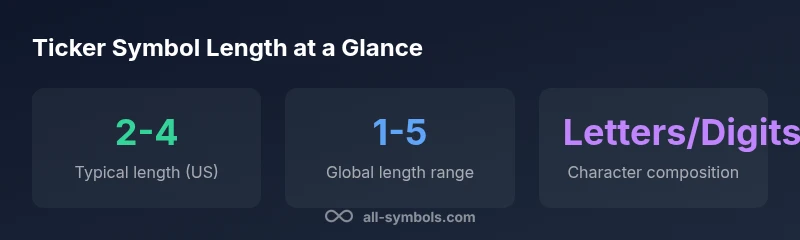
| United States tickers (US) | 2-4 characters | Primarily letters; exceptions exist |
| Global markets | 1-5 characters | Variation by exchange and country |
| Suffix/prefix conventions | Varies | Some markets use suffixes to denote class or listing |
Questions & Answers
What is a ticker symbol?
A ticker symbol is a short alphanumeric code used by exchanges to identify a security in quotes and data feeds. It ensures precise tagging of assets for trading and research.
A ticker symbol is a short code that helps you identify a security in feeds and quotes.
Can ticker symbols include digits?
Yes, some markets allow digits or mixed formats, especially for special listings or cross-listed securities. Always consult the local exchange rules.
Yes, some markets allow digits in tickers; check your exchange rules.
Why do ticker symbols vary by market?
Different exchanges publish their own length limits and formatting conventions. Historical practices and regulatory requirements also shape symbol design and suffix usage.
Markets have different rules and histories that shape symbol formats.
What happens when a ticker symbol changes?
A merger, spin-off, or rebranding can trigger a symbol change. Data providers typically map old tickers to new ones to preserve continuity.
Symbol changes occur after mergers or rebranding; data vendors map old to new.
Are tickers for ETFs different from stocks?
ETF and mutual fund tickers follow exchange conventions but may include suffixes or class indicators to distinguish listings.
ETFs follow the same rules but might have suffixes to distinguish listings.
Where can I find official symbol formats?
Official formats are published by each exchange or regulator; cross-check with issuer filings and exchange lookup tools.
Check the exchange's official listings and issuer filings for formats.
“Ticker symbol length is more than a stylistic choice—it directly affects data quality and cross-market comparability.”
The Essentials
- Ticker symbols are short identifiers used to label securities.
- US tickers typically range from 2-4 characters.
- Global markets vary; expect 1-5 character tickers.
- Suffixes or prefixes indicate extra information in some markets.
- Always verify symbol formats with the exchange for data accuracy.