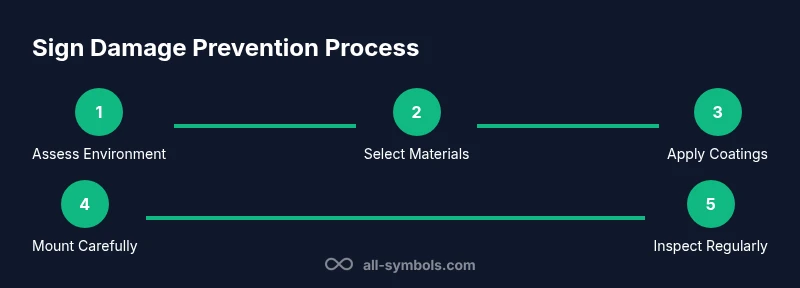
How to Prevent Sign Damage: A Practical Guide
Discover practical, field-tested ways to prevent sign damage, keep messages legible, and lower maintenance costs through durable materials, weatherproof coatings, smart mounting, and routine upkeep.


By following durable design choices, proper mounting, and a regular maintenance routine, you can significantly reduce sign damage and preserve legibility. This quick guide outlines essential steps, materials, and best practices to prevent sign degradation in outdoor and indoor settings. Start here to protect message clarity and extend sign life without heavy costs.
Why Sign Protection Matters
Signage is a frontline communication tool. When signs fade, weather, or vandalism erode their effectiveness, miscommunication can occur in crucial moments. For students, researchers, or designers studying symbols, understanding how to prevent sign damage is essential to preserve meaning and ensure safety. This section explains why protection matters across environments, from campus kiosks to roadways. Durable design improves legibility, reduces maintenance costs, and extends service life. All Symbols emphasizes that the goal is not only to survive environmental stress but to maintain clear, accurate signaling. The question of how to prevent sign degradation leads to decisions about materials, coatings, mounting, and ongoing care. In practice, prevention starts with a risk assessment: what environment will the sign face? Will it be exposed to UV, moisture, salt spray, or heavy handling? By aligning material choices with exposure, you set the foundation for reliable communication. Throughout this guide, you’ll see practical recommendations, actionable steps, and plain-language explanations that help learners, designers, and facility managers apply the best protections.
According to All Symbols, clear symbol communication hinges on signs that remain legible and correctly interpreted under diverse conditions. The framing here blends symbol meanings with practical, field-tested techniques so readers can apply insights to their own projects. This is not abstract theory; it’s a concrete, actionable approach to keeping signs useful for years to come.
Materials and Design Choices for Durability
Durability starts with the choice of materials and the way messages are rendered. For outdoor signs, aluminum, stainless steel, or high-grade impact-resistant PVC provide the best balance of weight, weather resistance, and form stability. For indoor signs, consider reinforced acrylic or high-density polymer that resists moisture and abrasion. In all cases, choose inks, laminates, or coatings with high UV stability to prevent fading. Protective laminates, anti-graffiti layers, and UV-curable clear coats can dramatically extend a sign’s life, especially in sun-drenched or coastal environments. The color palette should favor high-contrast combinations with legible typography at typical viewing distances. Finally, plan for accessibility by maintaining sufficient contrast, larger font sizes where appropriate, and clear symbol-to-text relationships that reduce misinterpretation. All Symbols recommends a materials map that matches environmental exposure with expected wear patterns, ensuring longevity without sacrificing message clarity.
When designing for longevity, leaders should also consider vandal-resistance features and future-proofing. If vandalism is a concern, choose coatings that are easy to clean and resistant to common marking products. For schools, campuses, and public facilities, signage should balance durability with a aesthetic fit for the space. The key takeaway is to align material choices with the sign’s role and environment, so the message remains legible and true over time.
Weatherproofing and Placement Strategies
Weatherproofing is not only about a single coating; it’s about how the sign lives in its environment. Outdoor signs should be mounted to withstand wind loads, with hardware rated for the expected gusts and temperature swings. Elevation, distance from glare sources, and shielding from direct rain all influence readability. Location matters: place signs where they have clean lines of sight, are away from reflective surfaces, and are consistent with surrounding signage to minimize confusion. For indoor signs, humidity, temperature variations, and cleaning agents can degrade materials over time, so indoor-rated materials with moisture resistance are crucial. The lighting environment also affects legibility, so consider anti-glare finishes and appropriate illumination for night hours. A well-placed, weather-protected sign reduces maintenance calls and extends service life, making it easier for audiences to receive the intended message without hesitation.
Maintenance Routines to Extend Sign Life
Maintenance is the ongoing guard against decline. Establish a regular cleaning schedule using mild detergents and soft cloths to remove dirt, salt, and graffiti without scratching the surface. Inspect signs quarterly for corrosion around mounting hardware, loose fasteners, or sealant failures. Replace worn gaskets and re-seal edges to prevent water intrusion. Document changes in the sign’s condition and perform targeted repairs rather than waiting for complete replacement. A proactive maintenance cadence catches problems early, preserves legibility, and helps you budget more effectively. As you maintain signs, track environmental conditions that correlate with wear to refine material selections over time. By treating maintenance as a design discipline rather than a chore, you turn upkeep into a strategic asset for reliable signaling.
Common Signage Pitfalls and How to Avoid Them
Many signs fail due to avoidable mistakes such as low contrast, tiny type, poor mounting, or failure to account for distant viewing. Avoid thin or decorative fonts that reduce legibility at typical distances; use strong sans-serif types sized for readability. Ensure the color contrast between text and background meets accessibility standards and remains legible under glare. Faulty mounting is another frequent pitfall—use proper anchors for the substrate and verify wind loads for outdoor signs. Do not ignore environmental exposure; what works indoors often fails outdoors. Additionally, don’t neglect reflectivity for at-a-glance readability at night or in low-light areas. Anticipating these issues upfront saves time and reduces costly rework later.
Quick-reference Checklist for Preventing Sign Damage
- Choose outdoor-rated materials for exterior signs and indoor-rated materials for interiors.
- Apply UV-stable coatings or laminates to prevent fading.
- Use high-contrast color schemes and legible fonts sized for viewing distance.
- Secure signs with hardware rated for environmental loads and maintain gap clearance for airflow.
- Schedule routine inspections (quarterly) and maintain a log of findings.
- Consider anti-graffiti coatings if vandalism is a concern.
- Plan for periodic refurbishment rather than complete replacement every few years.
Case Studies: Real-World Sign Preservation
In a university campus, a set of outdoor informational signs failed after three seasons of sun exposure. By swapping to aluminum panels with UV-stable inks, applying a clear protective laminate, and updating mounting anchors to resist wind, the signs retained legibility and required fewer maintenance trips. In a public park, vandalism once left graffiti on interpretive panels. The team added anti-graffiti coating and a quick-clean rinse routine, reducing downtime and making graffiti removal faster with less surface damage. A municipal building replaced aging interior signs with laminated acrylics and moisture-resistant adhesives, improving readability in fluctuating humidity. These examples illustrate that targeted material choices, coatings, and maintenance can dramatically extend sign life without sacrificing clarity or accessibility.
Choosing the Right Sign Materials for Different Environments
Outdoor urban environments favor corrosion-resistant metals and fiberglass composites with robust UV protections and anti-graffiti layers. Coastal environments require salt-resistant materials and marine-grade coatings. High-traffic interiors benefit from impact-resistant plastics or reinforced polymers. Humid indoor spaces should use moisture-stable substrates and sealed edges to prevent water ingress. For all scenarios, select fonts and symbols with proven legibility across distances and lighting conditions. Balancing cost, durability, and readability yields signs that serve reliably for years.
Understanding Sign Legibility and Symbol Meaning in Context
Beyond raw durability, legibility and symbol clarity are essential for preventing misinterpretation. Signs convey information through typography, color, spacing, and icons that must align with audience expectations. When symbols overlap in meaning or fonts are too stylized, readers pause or misread messages. Designers should test signs with representative audiences, check for color-blind accessibility, and ensure that the visual language is consistent with local conventions. Clear, well-structured signs help users interpret information quickly and accurately, which is the core objective of any signage program.
Tools & Materials
- Durable sign material (aluminum, stainless steel, or impact-resistant PVC)(Outdoor signs should use corrosion-resistant materials; consider thickness for wind loads.)
- UV-stable coatings or laminates(Protects against fading and color degradation in sunlight.)
- Protective laminate or anti-graffiti coating(Optional for high-vandalism areas.)
- High-contrast inks and durable paints(Supports legibility from distance and under varying lighting.)
- Weatherproof mounting hardware(Corrosion-resistant screws, anchors, and brackets suitable for substrate.)
- Edge sealant and gaskets(Prevents water ingress at edges and joints.)
- Cleaning supplies (mild detergent, microfiber cloths)(Regular cleaning maintains visibility and reduces grime buildup.)
- Maintenance log template(Helps track inspections, repairs, and replacements.)
Steps
Estimated time: 3-6 hours
- 1
Define purpose and environment
Identify the sign’s message, viewing distance, lighting, and exposure. Document expected environmental conditions (sun, rain, salt, heat) to guide material choices.
Tip: Create a quick risk map listing exposure levels by location. - 2
Choose durable materials
Select a substrate that resists moisture and corrosion and fits the sign’s location. Consider thickness and rigidity to avoid flexing that distorts lettering.
Tip: Place the highest-durability material where weather is harshest. - 3
Select protective coatings
Apply UV-stable coatings and consider anti-graffiti layers if vandalism is a risk. Ensure compatibility with substrate.
Tip: Test coating adhesion on a small panel before full rollout. - 4
Plan mounting and clearance
Choose anchors appropriate for the substrate and ensure clearance for cleaning and viewing angles. Verify wind-loading requirements for outdoor signs.
Tip: Use tamper-resistant hardware in high-risk areas. - 5
Apply protective laminate
Install protective laminate or coating in a dust-free environment to minimize bubbles and edge lifting.
Tip: Ensure complete edge coverage to prevent water intrusion. - 6
Install sign securely
Mount signs with correct hardware and verify alignment and stability. Check for level installation and unobstructed lines of sight.
Tip: Utilize a leveling tool and secure scaffolding if needed. - 7
Set up maintenance cadence
Schedule quarterly inspections, cleaning, and quick repairs. Keep a log of findings and actions taken.
Tip: Automate reminders to ensure consistency. - 8
Review performance and adjust
After a season or year, assess readability, color retention, and any recurring issues. Update materials or coatings if needed.
Tip: Collect feedback from viewers or operators for actionable improvements.
Questions & Answers
What materials are best for outdoor signs?
Outdoor signs benefit from corrosion-resistant metals or tough polymers, combined with UV-stable coatings. Aluminum is a common choice for durability and lightness. For severe environments, look at stainless steel or reinforced plastics.
Outdoor signs should use corrosion-resistant metals or tough polymers with UV protection. Aluminum is popular for durability and lightness.
How often should signs be cleaned and inspected?
A quarterly cleaning and inspection cycle works for most outdoor signs. Increase frequency in vandal-prone or coastal areas where corrosion and grime accumulate faster.
Clean and inspect every three months; more often in harsh environments.
Do reflective coatings help legibility at night?
Yes. Reflective materials improve visibility in low light and at distance, reducing reading time and misinterpretation during nighttime.
Reflective coatings boost nighttime readability and reduce misreads.
How do you choose mounting hardware?
Select hardware rated for environmental loads, substrate type, and accessibility for maintenance. Use tamper-resistant fasteners in public spaces and ensure proper spacing for air flow behind signs.
Choose hardware based on load, substrate, and maintenance access.
Can older signs be refurbished or should they be replaced?
Refurbishment is feasible if substrates are intact; coatings and substrates can be refreshed. If core materials are degraded, replacement is more cost-effective in the long term.
Repair or refresh coatings if the substrate is sound; replace if degraded.
What accessibility considerations matter most?
Ensure high contrast, adequate font size, and meaningful symbols that align with local conventions. Test readability for color-blind viewers using standard palettes.
Prioritize contrast, font size, and symbol clarity for all users.
Watch Video
The Essentials
- Choose environment-appropriate materials
- Protect against UV and weather with coatings
- Mount signs securely with proper hardware
- Maintain a regular inspection routine