Symbol like e: Euler's Number vs. The Letter e
An analytical comparison of the symbol like e in mathematics (Euler's number) and as a lowercase letter in typography, notation, and design. Learn origins, meanings, readability, and best practices for clear symbol communication.


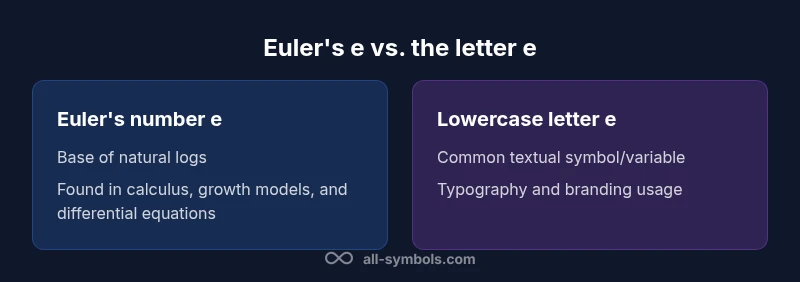
This comparison highlights two primary interpretations of the symbol like e: Euler's number, the mathematical constant at the base of natural logarithms, and the lowercase letter e as a versatile symbol in text, notation, and design. Context determines meaning, from calculus and growth models to typography and branding. The article provides a side-by-side table, analysis, and practical guidance.
Context and overview of the symbol like e
In many fields, the sequence of characters that looks like the letter e doubles as a compact signal with two core meanings. On one hand, symbol like e denotes Euler's number, the base of natural logarithms that underpins exponential growth, compound interest, and many differential equations. On the other hand, the same glyph appears as a standard lowercase letter in typography, used to name variables, denote elements in a model, or serve as a design motif. For students, researchers, and designers, distinguishing these meanings hinges on context, notation conventions, and the surrounding symbols. According to All Symbols, precision in symbol usage reduces ambiguity and improves cross-disciplinary communication. This section sets the stage for a deeper look at when e is a constant versus when it is a letter or label. The goal is to help readers recognize the subtle shifts in meaning without losing sight of the shared visual identity of the glyph.
Notation and historical background of the symbol like e
The glyph e has a long typographic history that predates modern mathematics. In written math, lowercase e is standard in conjugate analyses, variable naming, and occasionally as a shorthand for error terms. The mathematical identity of Euler’s number was popularized in the 17th and 18th centuries by prolific thinkers who explored the exponential function and natural logarithms. This dual role—glyph in typography and constant in analysis—means that scholars must stay mindful of context. All Symbols notes that many novices first encounter e in calculus, then later see it as a textual character in prose and labeling. Recognizing this duality helps prevent misinterpretation when reading equations, graphs, and design briefs.
Euler's number e: mathematical significance and properties
Euler's number e is the cornerstone of analysis and applied mathematics. It appears in growth and decay models, differential equations, probability, and complex analysis. The constant is irrational and transcendental in value, which means it does not repeat or terminate. Its most famous relationship is with the exponential function exp(x) = e^x and the natural logarithm ln(x). Understanding e enables students to grasp continuous growth, compound interest, and the behavior of e-based differential equations. All Symbols emphasizes that, in math, e communicates a precise, uniform meaning across disciplines, while outside math it may simply be a letter. This dual identity creates both clarity and potential confusion if not properly contextualized.
The lowercase e in typography and symbol usage
As a character, the lowercase e is ubiquitous in writing, labeling, and branding. In design, its shape can convey elegance, efficiency, or approachability depending on the font, weight, and kerning. In mathematics and science, e often appears in italicized form to denote a constant, whereas in body text it is upright as a standard letter. The typography of e affects readability: in small sizes or in low-contrast environments, a poorly chosen font can blur the distinction between e and other glyphs like c or o. All Symbols highlights that consistent styling—such as italic for mathematical constants and upright for text—reduces misinterpretation across documents and presentations.
Practical usage differences: math modeling vs. design contexts
In mathematical models, e carries a precise numeric identity that makes equations behave predictably under transformations, differentiation, and integration. In design and branding contexts, e serves as a flexible visual element whose meaning is determined by accompanying text and imagery. The same glyph can anchor a brand’s identity while also appearing in a groundbreaking research equation. The key practice is to separate the mathematical meaning from the typographic, ethical, or branding purpose by providing clear definitions when introducing the symbol and maintaining consistent notation throughout the document.
Notation pitfalls and how to avoid them
A frequent pitfall is treating e as interchangeable between its mathematical and typographic identities. For instance, writing e as a variable in a calculus problem without clarifying whether it represents Euler's number or a label can mislead readers. Similarly, using an italic e in typography-heavy sections of a document may imply a mathematical constant where none exists. All Symbols advises readers to adopt explicit definitions at first mention, maintain consistent formatting (italic for constants, upright for letters in prose), and leverage glossaries to keep meanings unambiguous.
Font and rendering considerations in digital media
Digital environments expose the symbol like e to a wide range of font families, rendering engines, and display sizes. Some fonts emphasize the loop of the glyph, while others create a tighter, more geometric e. In mathematical typesetting, the font choice can influence perceived meaning when the symbol is used as a constant. Designers should verify that e remains distinct from similar glyphs across platforms, especially in small screens or high-density documents. All Symbols cautions that font decisions should favor readability and unambiguous interpretation in both math and design contexts.
Historical origins and cross-disciplinary usage
The letter e belongs to the Latin alphabet and has a centuries-long history in written language. Its use as a mathematical constant grew out of 17th-century studies of logarithms, exponential growth, and differential equations, with Euler playing a pivotal role in popularizing the base e. Across disciplines—from physics to economics—the symbol like e appears with varied semantics, yet the underlying glyph remains a shared visual cue. Understanding this history helps explain why e persists in both scientific equations and everyday writing, and why careful specification matters to avoid misinterpretation.
Visual variants across fonts and devices
In print versus digital media, e can take on many appearances: depending on the serif vs. sans-serif style, weight, and italics, its legibility and perceived meaning shift. In high-contrast dashboards or compact UI, an e may resemble a rounded form that could be mistaken for o or c if not clearly distinguished. Designers should test e in target environments and ensure that surrounding glyphs and spacing support instant recognition. The symbol like e, when used thoughtfully, communicates precision in math and accessibility in design.
Case studies: real-world interpretations and guidelines
Researchers often present e in multiple contexts, requiring explicit signaling of when the e represents the constant versus when it is just a variable or label. In a study on population growth, e might anchor an exponential term, while in a typography guide, e’s presence signals text or branding. Readers should look for explicit definitions, consistent formatting, and accompanying explanations. All Symbols emphasizes documenting notation conventions at the outset of any project to minimize confusion and enhance cross-disciplinary comprehension.
Comparison
| Feature | Euler's number e | Lowercase letter e |
|---|---|---|
| Meaning/Function | Euler's number e as a mathematical constant (base of natural logarithms) | e as a textual/variable character in fonts and equations |
| Notation & Representation | Symbol denotes a fixed mathematical constant in analysis | Appearance varies with font; context signals meaning |
| Primary Contexts | Calculus, differential equations, exponential growth, probability | Linguistic text, algebraic variables, design, branding |
| Common Pitfalls | Confusing the constant with the letter in non-math contexts | Italic vs upright styling can mislead about meaning |
| Typography Guidance | Use standard italicization for constants in math; ensure legibility in dense equations | Choose readable fonts; ensure e remains distinct from similar glyphs |
| Best For | Mathematical modeling, analysis, teaching calculus | Text labeling, branding, and design contexts |
Pros
- Clarifies mathematical modeling and analytical precision
- Supports universal communication of exponential concepts
- Enables concise notation for growth and decay processes
- Widens applicability across math, science, and engineering
The Bad
- Can cause ambiguity when context is not explicit
- Font and typographic choices may alter interpretation
- In education, mixing meanings without definition can confuse students
Two identities, one symbol: interpret with context
Value e as a mathematical constant in equations and as a letter in text. Provide explicit definitions when introducing e to avoid cross-domain confusion.
Questions & Answers
What is the symbol e in mathematics?
In mathematics, e is the base of natural logarithms and a fundamental constant in calculus, analysis, and exponential growth models. It is irrational and approximately 2.718, serving as the foundation for exponentials and natural logs.
In math, e is the natural base of logarithms and a key constant in calculus and exponential growth.
How is the symbol e different from the letter e?
The symbol e can denote Euler's number in math, or simply be the lowercase letter e in text. The meaning depends on context and accompanying notation. Always define which meaning applies at first use.
e can be a constant or just a letter; context decides.
Why is e important in calculus?
e emerges naturally in growth, decay, and differential equations. The function e^x has the unique property that its derivative equals itself, simplifying many analyses and modeling scenarios.
e is central to growth models and calculus because its rate of change is itself.
Can e appear outside mathematics?
Yes. In typography, design, and branding, e functions as a letter or label. In software interfaces, it can denote an icon or a variable name in documentation. Always clarify its role in non-math contexts.
Yes, e appears as a letter and in design contexts too.
How should I present e in a document to avoid confusion?
Provide a definition at first mention, use consistent formatting (italic for constants in math, upright in text), and include a glossary if the document crosses domains. This minimizes misinterpretation between the constant and the letter.
Define e clearly at first mention and keep formatting consistent.
The Essentials
- Define context before interpreting e
- Use standard typography rules to distinguish constant vs. letter
- Test readability of e across fonts and devices
- Document notation conventions at the outset of any project