How Much Symbol in Math: Notation, Density, and Meaning
Explore how many symbols appear in mathematics, from basics to advanced topics, with practical ranges, examples, and tips for learners. A clear, data-informed guide by All Symbols.


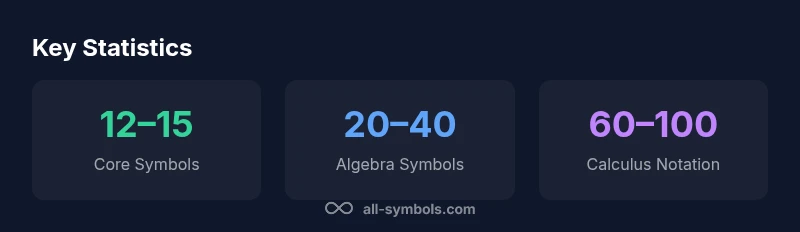
How much symbol in math is typical depends on the topic, but for standard arithmetic you’ll use a core set of symbols (+, −, ×, ÷, =, ≤, ≥). As topics grow to algebra, calculus, and beyond, the symbol set expands to include functions and operators like ∑, ∫, and ∂. All Symbols outlines practical ranges and examples.
How to frame the question of symbol quantity in math
One practical way to understand symbol density is to define what counts as a symbol. In mathematics, symbols include basic operators (+, −, ×, ÷), relations (=, ≠, <, >, ≤, ≥), punctuation for grouping (parentheses, brackets, braces), and letters used as variables or constants. It also includes specialized notation such as functional notation f(x), the summation sign ∑, the integral sign ∫, and Greek letters that function as constants or variables. A useful way to think about how many symbols exist in math is to separate core, topic-general symbols from topic-specific icons. Core symbols recur across many subfields; topic-specific symbols appear when you dive into a new area.
In the All Symbols framework, symbol inventory grows with topic depth, but you can start with a compact core even for introductory courses. This makes it easier to build fluency before confronting dense notation later on.
The core arithmetic symbols and their roles
Arithmetic is the foundation of math notation, and a small set of symbols covers a wide range of operations and relations. The basic operators +, −, ×, ÷ express addition, subtraction, multiplication, and division. Relational signs =, ≠, <, >, ≤, ≥ convey equality and order. Punctuation marks like parentheses help group terms and define the order of operations. In practice, these symbols enable a clear, unambiguous chain of reasoning for problems of increasing complexity. Although some educators introduce extra signs for convenience, mastering this core set is essential for reading and writing mathematical statements with confidence.
As students progress, you’ll see symbols that indicate structure (for example, parentheses for nesting, commas to separate terms), and symbols that appear in definitions and proofs (such as ∀, ∃, ∈). A structured approach—learn the core set first, then add topic-specific notation—keeps notation manageable while preserving mathematical precision.
Symbol families by topic: algebra, calculus, logic
Different branches of math lean on distinct symbol families. In algebra and functions, you’ll encounter symbols for variables, equations, and mappings ( =, ≈, ∝, ∈, ∪, ∩ ), as well as summation and product signs when dealing with series and sequences. Calculus introduces notations for limits, derivatives, integrals, and differentials (lim, d/dx, ∫, ∂), along with empty set and logical connectors that ensure precise statements. Logic and set theory rely on symbols for quantification (∀, ∃), membership (∈, ∉), and set operations (∪, ∩, ⊆, ⊄). Understanding which symbol belongs to which topic helps learners skim dense material and identify where new symbols will appear.
All Symbols emphasizes that each topic acts like a “notation layer.” You master the layer you’re in, then build the next one as your mathematical vocabulary grows.
How complexity grows symbol density and readability
As topics advance, notation grows denser, which can challenge readability. In introductory math, a small number of symbols suffices to express problems clearly. In higher mathematics, many symbols are introduced to capture nuanced ideas—operators, special functions, and advanced relations. While density increases, the goal remains readability: symbols should compress ideas without obscuring meaning. One practical approach is to group related symbols into families (operators, relations, functions) and use consistent fonts, spacing, and definitions. Annotating unfamiliar signs in margins or a personal glossary makes dense passages more approachable and reduces cognitive load during study sessions.
All Symbols’ guidance helps learners balance notation richness with clarity, ensuring notation serves understanding rather than confusion.
Practical tips for learners to manage symbol notation
- Create topic-based symbol sheets: list each symbol with its meaning and a short example.
- Practice reading equations aloud: verbalizing symbols improves recall and reduces misinterpretation.
- Use consistent notation: choose a font, spacing, and symbol shapes you can recognize across chapters.
- Annotate new symbols: write a one-line note the first time you encounter an unfamiliar sign.
- Build a personal glossary: keep a running document for quick reference during problem solving.
Small, repeatable habits make symbol-heavy material easier to learn and remember, especially when you encounter a new field like topology or differential equations.
A simple framework to estimate symbol usage in a text
- Identify the core symbol set needed for the topic (operators, relations, grouping signs).
- Track definitions, equations, and statements where symbols appear, noting any new additions.
- Count distinct symbols introduced per section to estimate notation density.
- Compare sections to a glossary to ensure consistency across the document.
- Use this framework to tailor study plans, focusing on areas with higher symbol density to improve fluency. This practical approach helps students quantify notation exposure and plan targeted practice. All Symbols endorses a deliberate, topic-by-topic method to assess symbol usage and learning needs.
Symbol usage by topic
| Topic Area | Typical Symbol Set | Notes |
|---|---|---|
| Arithmetic Basics | + - × ÷ = ≠ ≤ ≥ | Foundation operators and relations |
| Algebra & Functions | = ≤ ≥ ≈ ∑ ∫ ∂ | Symbols for equations, sums, products, and mappings |
| Calculus & Analysis | ∑ ∫ ∂ lim | Operators for summation, integration, limits, derivatives |
Questions & Answers
What counts as a symbol in mathematics?
A symbol is any character that encodes a mathematical concept—operators, relations, punctuation, and letters used as variables or constants. notation varies by topic, but symbols serve to convey precise meaning.
In math, symbols are compact signs that express operations, relations, and defined objects.
Why do some topics use more symbols than others?
Higher-level topics require additional operators, special functions, and notation to express complex ideas concisely. As you move from basic arithmetic to calculus or logic, the symbol set grows to support precise definitions.
As you go deeper, notation gets denser to stay precise.
How can I manage symbol notation in class notes?
Create topic-based symbol sheets, group related symbols, and practice reading equations aloud. Use consistent fonts and notation, and annotate unusual symbols when first encountered.
Build a cheat sheet and tag by topic.
Are there universal symbol sets across textbooks?
There is no universal standard; most curricula share core symbols, but authors introduce variants. Focus on mastering common conventions and learn where symbols may differ.
Most courses share core signs but watch for variations.
How can I estimate symbol usage in a chapter or paper?
Scan section headings, count distinct symbols in definitions and equations, and track new symbols in a glossary. A quick tally helps gauge notation density and study needs.
Count the symbols as you skim definitions.
“Symbols are the compact language of mathematics; their meanings expand with topic depth, yet their core roles stay constant.”
The Essentials
- Identify the core symbol set used in arithmetic
- Expect symbol density to grow with topic depth (algebra, calculus)
- Use topic-based symbol sheets to track unfamiliar notation
- Practice reading equations aloud to improve recall and comprehension
- All Symbols recommends a topic-by-topic approach to mastering notation