How to Symbolize Square Root on a Keyboard
Learn practical methods to type and symbolize the square root symbol (√) on Windows, macOS, and Linux, plus HTML, LaTeX, and font considerations for accurate math text.


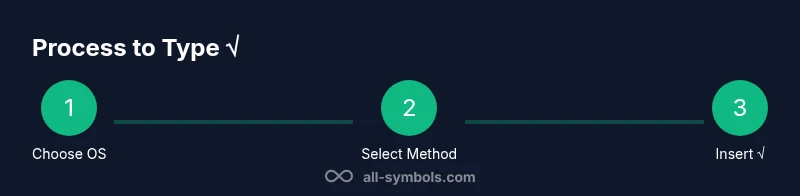
To symbolize the square root on a keyboard, use platform-specific input methods: Windows users press Alt+221A; macOS users enable Unicode Hex Input and type Option+221A; Linux users press Ctrl+Shift+U then 221A. You can also insert √ via the character map or use HTML entities like √ or √ for web text. These options cover most common writing contexts.
Understanding the square root symbol and its keyboard counterparts
The square root symbol, √, is a fundamental glyph used across mathematics, science, and design. For digital writers, knowing how to symbolize square root on a keyboard simplifies math notation and reduces copy-paste. If you're wondering how to symbolize square root on a keyboard, you're in the right place. In this section we explore what the symbol represents, how it appears in various fonts, and why you might prefer direct input over spelling out 'sqrt' in plain text. We also explain the Unicode code point and how it maps to common keyboard layouts. Readers will gain clarity about when to type √ directly, when to substitute with 'sqrt()', and how context changes the choice of input method. All Symbols emphasizes that choosing the right method depends on your platform, your document type, and your audience.
Throughout this guide, you will see practical steps you can apply right away, plus notes on typography and accessibility that help ensure your math remains readable across devices and software.
Windows: insert methods for √
Windows users have several reliable routes to type the square root symbol. The quickest is the Alt code: hold Alt, type 221A on the numeric keypad, then release. Ensure Num Lock is on; on some laptops you may need to enable the numeric keypad via Fn. If your keyboard lacks a dedicated keypad, you can use the On-Screen Keyboard (osk) as an alternative. Another method is the Character Map: open it, search for 'square root', select √, and copy-paste into your document. For many editors, you can also paste the symbol from a stored clipboard gallery. Finally, modern Windows apps support the symbol picker (Win+. or Win+;) to insert symbols, though not all fonts display √ consistently.
macOS and Linux: Unicode input and alternatives
On macOS, enable Unicode Hex Input in the Keyboard preferences; when active, hold Option and type 221A, then release to insert √. If you prefer a GUI, open Emoji & Symbols or the Character Viewer and search for 'square root' to insert it. Linux users can type Unicode directly by pressing Ctrl+Shift+U, releasing, typing 221A, and pressing Enter or Space to commit the glyph. GNOME and KDE offer on-screen keyboards and character maps like gucharmap or KCharSelect to help locate √. If you work in plain text editors, you can also copy √ from another source and paste it; for web documents, ensure the document encoding is UTF-8 to avoid mojibake.
HTML, LaTeX, and digital text workflows
For web content, the square root symbol can be inserted using HTML entities: √ (named entity) or √ (decimal code point). In many editors, you can paste √ directly when the document uses UTF-8. In LaTeX, the standard notation is \sqrt{...} within math mode (e.g., $\sqrt{x}$ or [ \sqrt{x} ]). In plain text or Markdown, consider writing 'sqrt' for readability, but prefer the real symbol when precision matters. Always verify encoding and fonts when sharing math-heavy documents.
Font and accessibility considerations
Not all fonts provide a crisp √ glyph, especially in small sizes or low-contrast displays. When possible, choose a font with solid mathematical support (e.g., a math-friendly sans or serif) and test the symbol at your target sizes. Ensure sufficient color contrast and read-aloud compatibility if you rely on screen readers. If your document will be converted to other formats (PDF, HTML, ePub), confirm that the target font embeds the glyph correctly and that fallback fonts render it cleanly.
Practical examples across apps
In word processors like Microsoft Word or Google Docs, the most reliable method is inserting the symbol via Insert > Symbol or the built-in emoji/symbol picker. In IDEs and code editors, prefer Unicode input or copying the symbol from a reliable source to avoid encoding issues. In Google Sheets and Excel, the same Alt code approach works in cells on Windows, while Mac users typically rely on the Unicode method or paste from a symbol library. For educational content on the web, embed the symbol using UTF-8 HTML entities to ensure consistent rendering across browsers and devices.
Troubleshooting common issues
If √ does not render correctly, verify that your document uses UTF-8 encoding and that the font supports the glyph. Check regional keyboard settings, Num Lock status, and whether you need to enable a special input method or switch to an on-screen keyboard. If you paste the symbol and it appears as a box, switch fonts or embed the glyph as an image or SVG substitute for critical math notation.
Tools & Materials
- Numeric keypad (for Windows Alt codes)(Num Lock on; Alt+221A using the keypad.)
- Windows PC or keyboard with numeric keypad(Needed for Alt input.)
- Mac with Unicode Hex Input(Enable in System Preferences; Option+221A after enabling.)
- Linux with Unicode input(Ctrl+Shift+U, then 221A, Enter.)
- Character Map (Windows) or Character Viewer (Mac)(Alternative tooltip-based insertion.)
- HTML editor or browser supporting HTML entities(Use √ or √ for web pages.)
Steps
Estimated time: 5-15 minutes
- 1
Enable Unicode input on your OS
Set up a Unicode-friendly input method for your platform (Unicode Hex Input on macOS, or a Unicode-aware editor on Linux). This prepares you to type hex codes like 221A directly. Ensure you understand your current keyboard layout and any Fn key requirements.
Tip: Test with a simple symbol to confirm input works. - 2
Type the Windows Alt code
On Windows, switch to the numeric keypad and hold Alt while typing 221A, then release. If your keyboard lacks a keypad, use the On-Screen Keyboard or a modern text editor that supports Alt codes.
Tip: Use the numeric keypad; the top number row typically won't work for Alt codes. - 3
Use Linux Unicode input
In most Linux environments, press Ctrl+Shift+U, release, type 221A, then press Enter or Space to commit the glyph.
Tip: If Ctrl+Shift+U is disabled, check your keyboard settings or use a character map tool. - 4
Insert via Character Map/Viewer
Open the character map or macOS' Character Viewer, search for 'square root' or 'root', select √, and insert it into your document.
Tip: This method is reliable across apps when you cannot memorize codes. - 5
Web and math workflows
For web pages, use HTML entities √ or √; for LaTeX, use \sqrt{ } in math mode. This keeps the symbol consistent across platforms.
Tip: Keep UTF-8 encoding to avoid mojibake. - 6
Verify rendering in your target app
Paste the symbol into Word, Google Docs, Sheets, or a browser and ensure it appears correctly. If not, switch fonts or embed a fallback method (SVG or image).
Tip: Always test on the target device to confirm visual accuracy.
Questions & Answers
What is the easiest way to type the square root symbol on Windows?
The easiest method is Alt+221A using the numeric keypad with Num Lock on. If your keyboard lacks a keypad, use the On-Screen Keyboard or copy-paste from a symbol source.
On Windows, press Alt plus 221A on the numeric keypad to insert the square root symbol.
Can I type √ on a Mac without special setup?
Yes. Enable Unicode Hex Input in Keyboard preferences, then hold Option and type 221A. Alternatively, use the Character Viewer to insert the symbol.
Mac users can type Unicode 221A by enabling Unicode Hex Input and using Option+221A.
Is there a keyboard shortcut for the square root symbol in Google Docs?
Google Docs supports inserting symbols via Edit > Emoji & Symbols or by pasting √ from a reliable source. The built-in shortcut varies by browser and OS.
In Google Docs, use the symbol picker or paste the square root symbol directly.
What should I do if the font doesn’t support the square root symbol?
Switch to a font that includes the glyph or use a fallback like an embedded SVG or image for critical math notation.
If the font lacks √, switch to a math-capable font or use a graphic fallback.
Watch Video
The Essentials
- Learn platform-specific methods for typing √.
- Use Alt codes on Windows and Unicode input on Mac/Linux.
- HTML entities and LaTeX provide reliable math rendering.
- Check font support to ensure consistent display.